Key Takeaways
- C9 bulbs measure 1⅛ inches in diameter and use an E17 medium intermediate base — significantly larger and brighter than C7 or mini lights, making them ideal for rooflines, large trees, and commercial facades across New Hampshire.
- LED C9s consume up to 80% less energy than incandescent versions and maintain consistent color output even when temperatures drop below 0°F — a real advantage during a typical NH winter.
- Warm white, cool white, and multicolor are the most popular C9 color choices for NH homes; each creates a distinctly different curb-appeal effect from the street.
- Cedar shake, vinyl siding, brick, and granite are the four most common exterior surfaces in New Hampshire — each requires a different clip or mounting strategy to protect the material and hold lights securely through ice and wind.
- Booking C9 installation before October 1st is strongly recommended in NH, when rooflines freeze and scheduling fills fast through the holiday season.
Picture a mid-December evening on a New Hampshire neighborhood street. Snow is drifting past the pines, and one house stops you cold — not because of its size, but because of the row of glowing orbs marching across its roofline like a string of small suns. Those are C9 bulbs, and they have been the backbone of professional holiday lighting displays in New England for more than a century. If you have ever wondered why some houses look polished and intentional while others look like an afterthought from a big-box store, the answer almost always comes down to bulb choice. This guide breaks down everything a New Hampshire homeowner needs to know about C9 bulbs — sizes, bases, LED versus incandescent, color options, and exactly how to mount them on the surfaces that define granite-state architecture.
What Is a C9 Bulb? Size, Shape, and Base Explained
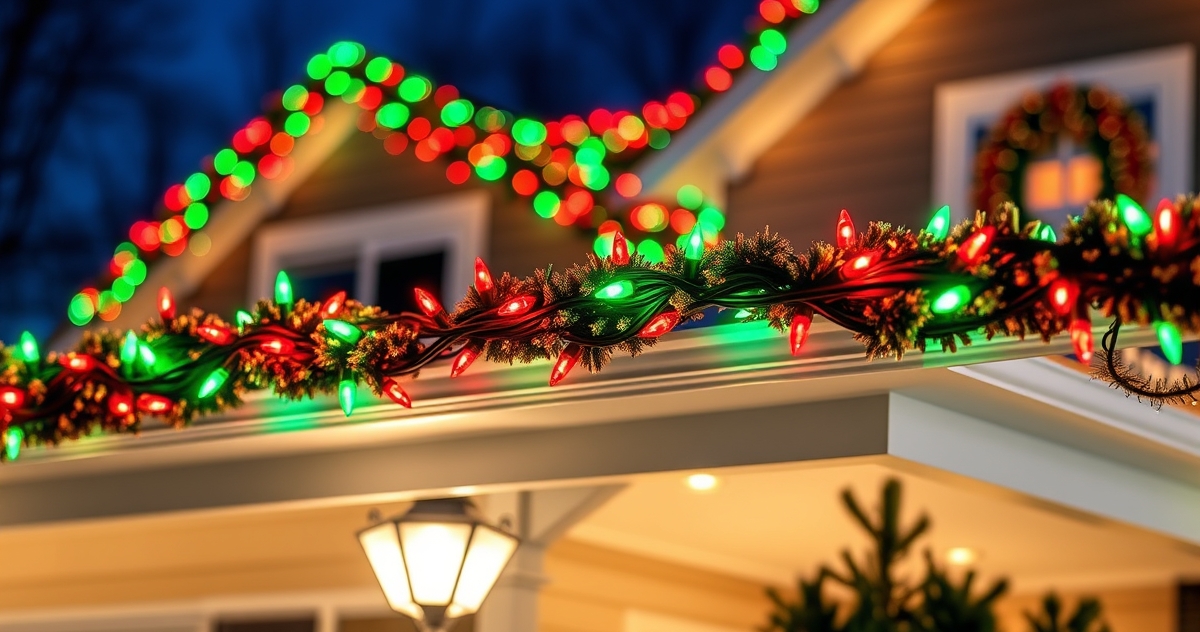
A C9 bulb is a conical, faceted holiday light bulb measuring approximately 1⅛ inches (roughly 29 mm) in diameter, seated on an E17 medium intermediate base. The "C" stands for "conical" and the "9" refers to the bulb's diameter in eighths of an inch — so 9 eighths equals 1⅛ inches. C9 bulbs are designed to be seen from a distance, which is why they work so well on rooflines, fence posts, large evergreen trees, and commercial storefronts where the display needs to read clearly from the street or a parking lot.
How C9 Compares to C7 and Mini Lights
Understanding where C9 fits in the bulb family makes it easier to choose the right product for each part of your property.
| Bulb Type | Diameter | Base Type | Typical Spacing on String | Best Use on NH Homes |
|---|---|---|---|---|
| Mini Lights | ~5/16 in. | Wedge or E10 | 2–4 inches | Shrubs, wreaths, garlands, window frames |
| C7 | ~7/8 in. | E12 candelabra | 12 inches | Gutterlines on smaller capes and cottages, pathway posts |
| C9 | ~1⅛ in. | E17 intermediate | 12–18 inches | Rooflines, large trees, commercial facades, fence lines |
Mini lights are the go-to for detail work — wrapping ornamental grasses, lighting wreaths, or tucking into shrub and landscape plantings. C7s occupy the middle ground and look attractive on the gutterlines of smaller New Hampshire cape-style homes. C9s, however, are the statement bulb — they project visible light across a yard or parking lot even in a New England snowstorm, and their size means each individual bulb becomes a design element in its own right. For a deep dive into mini lights and their specific spacing rules, see our mini lights complete guide.
LED vs. Incandescent C9 Bulbs in New Hampshire's Climate
LED C9 bulbs outperform incandescent models in virtually every metric that matters to a New Hampshire homeowner, with energy savings of 75–80% being the most immediately obvious benefit.
Energy Costs: The Numbers That Matter in NH
New Hampshire electricity rates consistently rank among the highest in the continental United States, hovering around 20–22 cents per kWh in recent winters. A standard incandescent C9 bulb draws about 7 watts. An LED replacement draws roughly 0.96–1.2 watts. Run a 100-bulb roofline display for eight hours a night across a 45-day season:
- Incandescent: 100 bulbs × 7W × 8 hrs × 45 days = 252,000 Wh (252 kWh) ≈ $55.44 at $0.22/kWh
- LED: 100 bulbs × 1.1W × 8 hrs × 45 days = 39,600 Wh (39.6 kWh) ≈ $8.71 at $0.22/kWh
That is roughly $47 in savings on a single roofline. Scale that to a full commercial or municipal display and the numbers become very significant very quickly.
Cold-Weather Performance
LED C9 bulbs actually become more efficient as temperatures drop — solid-state electronics run cooler and more stably in the cold. Incandescent C9s, by contrast, can dim slightly in extreme cold and their filaments are more vulnerable to the freeze-thaw cycling that is a hallmark of a New Hampshire winter. Ice dams, wind gusts off the White Mountains, and temperature swings of 30°F in a single day put real mechanical stress on incandescent filaments. LED bulbs have no filament to break; their rated lifespan is typically 25,000–50,000 hours compared to 1,000–2,000 hours for incandescent C9s. For a broader look at how holiday lighting technology has evolved, our history of string lights from Edison to LED tells that story well.
Choosing the Right C9 Color for Your New Hampshire Home
Color choice is the single biggest driver of curb appeal in a holiday lighting display, and C9 bulbs — because of their size — make color decisions more consequential than with smaller bulbs.
Warm White C9 Bulbs
Warm white C9s (approximately 2700–3000K color temperature) produce a soft amber-tinged glow that complements the wood tones of cedar shakes, the warmth of brick, and the natural stone of granite foundations. They read as timeless and elegant from the street and photograph beautifully against a snowy background. Warm white is consistently the most popular choice for colonial, farmhouse, and craftsman-style homes across southern and central New Hampshire.
Cool White C9 Bulbs
Cool white C9s (5000–6500K) produce a crisp, icy blue-white light that feels contemporary and pairs particularly well with modern farmhouse architecture, white vinyl siding, and homes with a lot of glass. Cool white rooflines look striking against a clear New Hampshire winter night sky and can evoke the blue-white of fresh snow.
Multicolor C9 Bulbs
Classic multicolor C9 displays — cycling through red, green, orange, blue, and yellow — are a nod to the deep tradition of holiday lighting in New England. LED multicolor C9s offer saturated, vivid hues that stay consistent through the entire season without fading the way incandescent lenses do. Multicolor works best on larger homes, commercial properties, and municipal displays where the visual scale supports the variety of colors. For patriotic events and summer holidays, red, white, and blue C9 configurations have their own distinct appeal — see our post on red, white, and blue C9 displays for the Fourth of July in NH.
Best Mounting Surfaces for C9 Strings in New Hampshire
New Hampshire homes present a wider variety of exterior surfaces than almost anywhere else in New England — cedar shakes, vinyl siding, antique brick, and exposed granite foundations are all common, and each demands a different approach to mounting C9 strings safely and without damage.
Cedar Shake and Wood Siding
Cedar shake is beautiful and relatively forgiving for clip attachment, but it is also the surface most easily damaged by improper fasteners. Never use staple guns or nails directly into shakes for C9 strings — the wood splits and the water infiltration over a NH winter causes rot. Instead, use all-in-one gutter hooks or S-clips that attach to the lip of the gutter or the edge of a shake without penetrating the wood. For roofline applications on cedar homes, professional installers typically use adjustable shingle tabs that grip the lower edge of each shake. Our roofline lighting installation overview covers this in detail.
Vinyl Siding
Vinyl is the most common exterior cladding on post-1980 New Hampshire homes and is actually one of the easier surfaces to work with for C9 installation. Vinyl gutter hooks slip over the lip of gutters without fasteners, and all-in-one clips that grip the bottom channel of vinyl siding panels allow clean, no-drill attachment. The key caution with vinyl in NH is thermal contraction — vinyl shrinks measurably in cold weather, so clips should be spaced to allow slight movement rather than pulled taut. Always use clips rated for outdoor use to prevent brittleness in sub-zero temperatures.
Brick
Brick facades appear frequently on older commercial buildings in Concord, Manchester, Nashua, and Portsmouth, as well as on many colonial-era residences. C9 strings on brick require either adhesive light clips rated for masonry or, in professional installations, small masonry hooks driven into mortar joints (never into the brick face itself). Adhesive clips should be applied above freezing and given proper cure time before loads are applied — a challenge in NH's short autumn window. For large commercial brick facades, a custom-fabricated wire framework mounted at anchor points is often the cleanest solution. Learn more about what goes into commercial holiday lighting installations.
Granite Foundations
Exposed granite foundations are a signature element of older New Hampshire farmhouses and mill-era buildings. C9 strings along a granite foundation or garden wall create a dramatic low-lighting effect, but granite's irregular surface makes adhesive clips unreliable. The professional approach is to use weighted or staked ground clips along the base, or to run C9 strings through small eye hooks mortared into the joints between granite stones. This approach keeps the string secure through the freeze-thaw cycles that would pop adhesive clips loose by January.
Spacing, Circuit Planning, and Safety for C9 Displays
C9 strings are typically sold with sockets spaced 12 or 18 inches apart. For rooflines, 12-inch spacing delivers a fuller, more luminous look; 18-inch spacing works well on fence lines and longer runs where a slightly more restrained look is preferred. Most residential-grade C9 strings run 25 to 100 sockets per strand and are rated at 15 amps per circuit.
- Do not exceed 80% of a circuit's rated amperage — a 15-amp circuit should carry no more than 12 amps of load.
- LED C9s draw so little power that you can run far more per circuit than incandescent — often 10× as many sockets on the same breaker.
- Use outdoor-rated extension cords (16-gauge minimum for runs up to 50 feet; 14-gauge for longer runs).
- All connections and extension cord joints should be kept off the ground and away from standing water or snow accumulation.
- Ground fault circuit interrupters (GFCIs) are required by code for all outdoor outlets in New Hampshire — confirm yours are functioning before the season.
If you are planning a display that goes beyond a single roofline — wrapping trees, lighting pathways, and decorating a garage facade simultaneously — consider booking a professional site assessment. Our team handles full residential holiday lighting design and installation across New Hampshire, from the Seacoast to the Lakes Region to the Upper Valley.
Planning Your C9 Display: Timing, Removal, and Storage
New Hampshire's window for safe outdoor light installation is narrower than most homeowners realize. By late October, nighttime temperatures can dip below freezing across much of the state, making adhesive clips less reliable and ladder work on icy gutters genuinely dangerous. We recommend scheduling C9 installations in September or early October to ensure ideal conditions. If you are still in the planning phase, our post on why to book holiday light installation in June in NH explains exactly why early reservations matter.
After the season, professional removal and storage services protect your investment. LED C9 bulbs can last a decade or more if stored properly — coiled loosely, kept dry, and protected from rodents in a climate-stable space. Our removal and storage service handles take-down, bulb inspection, and organized storage so your display is ready to deploy again next November without tangles, broken sockets, or missing clips.
For homeowners thinking even further ahead, permanent lighting systems using architectural-grade LED fixtures eliminate the annual install-and-remove cycle entirely, with color and pattern changes controlled by an app — a growing option for NH homes where the roofline access is difficult or the homeowner simply wants year-round flexibility.
Frequently Asked Questions
What is the difference between a C9 and a C7 bulb?
A C9 bulb is approximately 1⅛ inches in diameter and uses an E17 intermediate base, while a C7 is roughly 7/8 inches in diameter and uses a smaller E12 candelabra base. C9s project significantly more light and are best suited to rooflines, large trees, and commercial displays visible from the street. C7s work well for smaller eaves, gutterlines on cottage-style homes, and decorative pathway posts where a slightly subtler look is preferred.
How many C9 LED bulbs can I run on one 15-amp circuit in New Hampshire?
A standard 1.1-watt LED C9 bulb draws about 0.009 amps. On a 15-amp circuit loaded to the recommended 80% (12 amps), you could theoretically run over 1,300 LED C9 bulbs on a single circuit — vastly more than the typical residential roofline display. In practice, the limiting factor is usually the rated capacity of the wire leads on your string sets, not the circuit breaker. Always follow the manufacturer's maximum connection guidelines for daisy-chained strings.
Will C9 bulbs stay lit in New Hampshire's sub-zero winter temperatures?
LED C9 bulbs are engineered to perform reliably in temperatures as low as -40°F and actually run more efficiently in cold conditions. Incandescent C9s can dim slightly in extreme cold and are more vulnerable to filament failure caused by freeze-thaw vibration. For a New Hampshire home that may see extended sub-zero stretches from December through February, LED C9s are the clear choice for consistent, worry-free performance.
What clips should I use to mount C9 strings on vinyl siding?
All-in-one vinyl siding clips that grip the bottom lip of each siding panel channel are the most popular no-drill option for NH vinyl exteriors. For gutterlines, adjustable gutter hooks that slip over the gutter edge work well and can be repositioned easily. Always choose clips rated for outdoor use in cold climates — cheaper plastic clips become brittle below 20°F and can snap under the weight of accumulated ice on the wire. Space clips at the socket interval of your string (typically 12 or 18 inches) to prevent sagging.
Can C9 bulbs be used for events and seasons other than Christmas in New Hampshire?
Absolutely. C9 bulbs in red, white, and blue are widely used for Fourth of July and Memorial Day displays across NH. Warm white C9 strings work beautifully as perimeter lighting for outdoor events, barn weddings, and harvest festivals. Multicolor C9s can mark the opening of a business or a seasonal market. Their visibility at distance makes them excellent for any application where you need a display to read from the road or across a large outdoor space. See our guide to outdoor event lighting for NH venues for more ideas.
Should I hire a professional to install C9 lights on my New Hampshire home?
For single-story homes with straightforward rooflines, confident DIYers can manage C9 installation with the right clips, a stable ladder, and attention to circuit loading. However, for two-story and larger homes, steep or complex rooflines, granite or brick surfaces, or displays involving multiple zones and circuits, professional installation is strongly recommended. Ladder accidents and electrical issues from overloaded circuits or outdoor connections exposed to snow melt are the two most common problems in DIY holiday lighting. A professional team brings commercial-grade equipment, liability insurance, and the experience to work efficiently before the NH weather window closes.
Ready to plan a C9 display for your New Hampshire home or business? Contact us today for a free estimate — our team serves residential, commercial, and municipal clients across the state and books quickly as the season approaches.