Key Takeaways
- New Hampshire storefronts see their heaviest foot traffic from November through January — professional holiday lighting directly increases after-dark visibility and impulse visits.
- C9 bulbs excel on rooflines and architectural edges; mini lights are the right tool for windows, railings, and interior display layers.
- Warm white creates an inviting, upscale feel; cool white projects a crisp, modern image — your brand tone should drive the choice.
- Permitting, landlord approval, and installer scheduling must start by August for a clean November 1 install date across most NH municipalities.
- A professional commercial lighting crew handles the logistics — power load calculations, lift equipment, and seasonal takedown — so your staff never has to.
Walk any main street in Keene, Laconia, or Portsmouth between Thanksgiving and New Year's Eve and you'll notice the same pattern: the storefronts with bold, well-executed holiday lighting pull pedestrians off the sidewalk like a magnet. Studies from the Retail Advertising and Marketing Association consistently show that illuminated exteriors increase after-dark foot traffic by 20–30% during the holiday shopping season. In a state where winter darkness falls before 4 p.m. and shoppers are actively hunting for local options, that margin is the difference between a record December and a forgettable one. Planning a commercial holiday display in New Hampshire isn't simply about stringing a few lights — it's a coordinated project with product decisions, permit timelines, power budgets, and installation logistics that all need to line up before the first hard frost arrives.
Why NH Storefronts Need a Dedicated Holiday Lighting Strategy
New Hampshire's retail calendar compresses dramatically in winter. The stretch from the week before Thanksgiving through the first week of January represents a disproportionate share of annual revenue for most main-street businesses — gifts, dining, services, and hospitality all spike. Meanwhile, daylight shrinks to roughly 9 hours by December 21, meaning a significant portion of every business day is conducted in the dark. A storefront that is dim, unlit, or decorated with a few dollar-store strands communicates the wrong message at exactly the wrong moment.
Professional commercial holiday lighting addresses this directly. A correctly designed display makes your facade legible and attractive from a moving vehicle, signals that your business is open and active, and creates the kind of photo-worthy curb appeal that generates organic social media shares — free advertising in the busiest shopping weeks of the year. For historic downtown districts common throughout New Hampshire, lighting also participates in a collective ambiance that draws visitors from across the region specifically to experience the scene. That rising tide lifts every business along the block.
C9 Bulbs vs. Mini Lights: Choosing the Right Product for Your Facade
The two workhorses of commercial storefront lighting are C9 bulbs and mini lights, and each has a distinct role determined by scale, viewing distance, and architectural detail.
C9 Bulbs for Rooflines and Architectural Edges
C9 bulbs — the large, faceted 5-watt LED lamps on a heavy-gauge SPT-2 cord — are built for exterior structural runs where visibility from the street is the primary goal. Their generous size (roughly 2.25 inches tall) and wide beam angle make them readable from 100 feet or more, which is exactly what you need when a driver is passing at 25 mph and you have one second to register your building. On a roofline, a run of warm white C9s spaced 12 inches apart traces the architecture cleanly and communicates scale — a customer can immediately gauge that this is a serious, established business. Cool white C9s on the same roofline project a crisper, more contemporary image that works well for modern retail, tech services, or any brand with a clean aesthetic.
For a deep dive into lamp sizing, base types, and spacing math, our complete C9 bulb guide covers every variable. For the roofline installation itself, our roofline installation overview walks through clip systems, ridge-cap anchoring, and safety considerations on commercial structures.
Mini Lights for Windows, Railings, and Display Layers
Mini lights — the 5mm or M5 LED lamps on 22-gauge wire — are the right tool anywhere fine detail matters: window frames, interior display staging, railing wraps, and garland infill. Their small profile disappears during the day and creates a dense, twinkling field at night that draws the eye to your storefront glass. A warm white mini-light border on a divided-light window is one of the most classic and effective retail displays in New England, adding depth and warmth without blocking merchandise. Cool white mini lights layered behind a window display can create a backlit effect that makes your products pop even after dark.
Spacing and strand selection make a real difference in final quality. Our mini lights complete guide explains the difference between 4-inch and 6-inch spacing, M5 vs. wide-angle lenses, and how to layer strands for commercial density without overloading circuits. For window-specific strategy, see our post on window display lighting and curb appeal — the principles translate directly to retail.
Warm White vs. Cool White: A Quick Decision Framework
| Consideration | Warm White (2700–3000K) | Cool White (5000–6000K) |
|---|---|---|
| Brand tone | Traditional, cozy, upscale, artisan | Modern, tech-forward, clean, energetic |
| Best facade materials | Brick, wood, painted Victorian trim | Glass, metal, concrete, contemporary signage |
| Street visibility at distance | High — amber glow reads well in NH winter fog | Very high — blue-white cuts through darkness sharply |
| Interior merchandise interaction | Flatters warm-toned products (food, apparel, gifts) | Flatters cool-toned products (electronics, jewelry, housewares) |
| Mixed-use compatibility | Blends seamlessly with other downtown warm displays | Creates contrast that can differentiate your block position |
Designing the Display: Scale, Layers, and Accessories
A complete commercial display uses lighting as its foundation but fills in with dimensional elements that give the facade life at close range. The most effective NH storefront displays we install combine three layers: a structural roofline or canopy run (C9 bulbs), a window and railing treatment (mini lights), and accent elements like garland, wreaths, and bows that add texture and signal seasonal intent unmistakably.
- Roofline run: Measure your full linear roofline — including any dormers, awning edges, or parapet caps — and specify C9s at 12-inch spacing. A 60-foot facade requires approximately 60 sockets plus 10% overage for corners and tie-offs.
- Window frames: Mini lights stapled or clipped to the interior of divided-light windows at 4-inch spacing create a dense, professional border. For large display windows, a cascading interior strand arrangement adds depth.
- Garland and wreaths: Pre-lit commercial garland (typically 9-foot sections with integrated LEDs) draped over entryways and doorframes adds a three-dimensional element that flat strand lighting cannot replicate. A well-proportioned wreath on the entry door — see our wreath decoration ideas guide — signals warmth and welcome at the moment of decision.
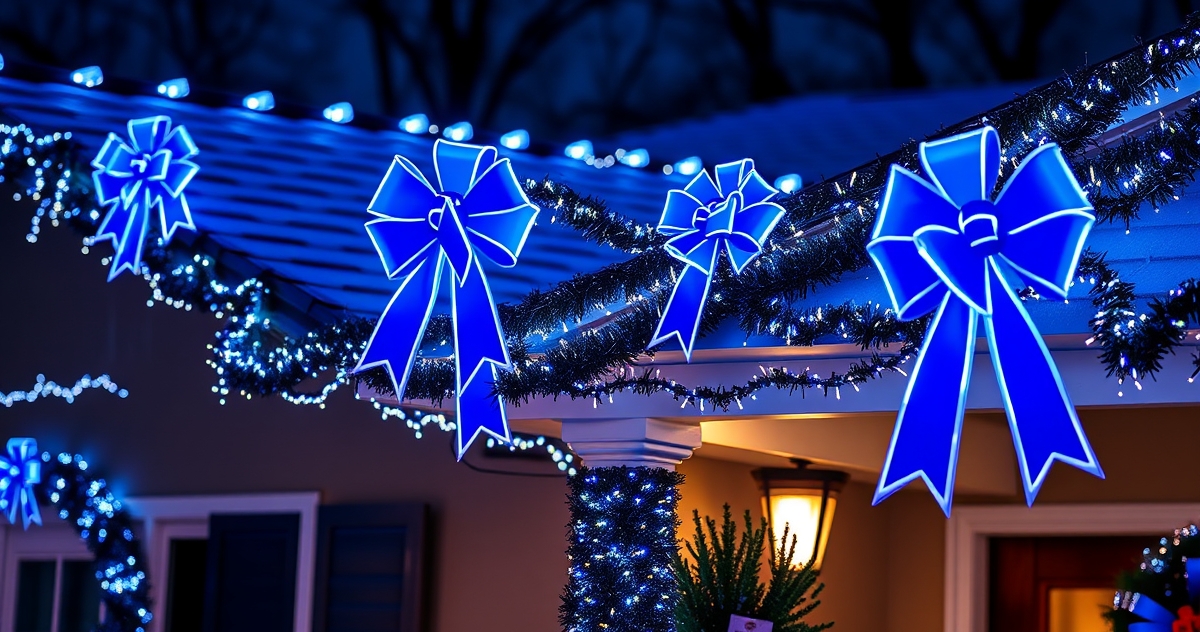
- Bows: Large commercial bows (18–24 inch) in red or plaid anchored to lamp posts, door handles, or garland swags add traditional New England character. Our bow selection guide covers weather-resistant materials and mounting hardware rated for NH winters.
- Tree or planter lighting: Street trees or planters in front of your store wrapped in warm white mini lights extend your display's footprint to the sidewalk edge, creating a branded zone rather than just a lit building. Our team handles commercial tree lighting alongside facade work on the same install day.
Permits, Landlord Approval, and the August Deadline
The single most common mistake commercial clients make is treating holiday lighting as a November project. By the time you're thinking about it in October, your installer's schedule is full, the permit office has a backlog, and your landlord's property manager needs two more weeks to respond. In New Hampshire, the planning window for a November 1 install needs to open in August — without exception.
Municipal Permitting in NH
Requirements vary by municipality, but as a general rule, any exterior attachment to a commercial building — including temporary lighting — that requires electrical connection to the building's service panel or a generator may trigger a building or electrical permit. Cities like Concord, Manchester, and Nashua have active code enforcement during the holiday season. The permit application itself is usually straightforward and low-cost (often under $75), but approval timelines can run 3–6 weeks in busy fall seasons. Some towns in the Lakes Region and Seacoast also require Historic District Commission review if your building is within a designated historic zone — add another 4 weeks for that process. Start the inquiry in August, submit by September 1, and you'll have approval in hand before your installer needs to book the crew and equipment.
Landlord and Property Management Approval
If you lease your space, your lease almost certainly requires written landlord approval for any exterior modification, including lighting attachments. Property management companies typically route these requests through a maintenance or facilities team that meets on a scheduled basis — weekly at best, monthly at many regional firms. A request submitted in late October may not clear until mid-November, leaving you scrambling. Submit a written request with a product spec sheet and installation plan in August. A professional installer can provide this documentation as part of the quoting process, which is another reason to book in August rather than waiting.
Power Load and Electrical Review
Commercial installers perform a load calculation before any job. A typical 60-foot facade with C9 roofline, window mini lights, and garland runs draws between 800 and 1,400 watts depending on strand count and bulb type. Most commercial panels handle this on a dedicated 15-amp circuit without issue, but older buildings common in NH downtowns sometimes have undersized service or fully loaded panels. Identifying this in August gives time to schedule an electrician if a dedicated circuit or GFCI outlet needs to be added — a one-day job that becomes a three-week wait in October.
Working with a Professional Installer: What to Expect
A professional commercial holiday lighting installation from Holiday Lights Decor New Hampshire includes site assessment, custom design, product procurement, installation, a mid-season check visit, and end-of-season removal and storage. You don't purchase the lights — we maintain the inventory, which means consistent product quality year over year and no storage burden on your end.
- August–September: Site visit, design proposal, permit documentation, landlord approval package.
- October: Product sourcing confirmed, install date locked, crew and lift equipment scheduled.
- November 1–15: Installation window — most NH commercial installs complete in one day for facades under 80 linear feet.
- December: Mid-season check to replace any failed bulbs and confirm timer settings.
- January: Takedown, inventory audit, and storage for the following season.
For businesses managing multiple locations across New Hampshire — restaurant groups, regional retailers, bank branches — our team coordinates staggered install dates and standardized design packages so every location opens the season on the same day with the same brand look. Learn more about our full range of holiday lighting services.
Frequently Asked Questions
How far in advance should I book commercial holiday lighting installation in New Hampshire?
Book by August for a November installation. Professional commercial installers in New Hampshire fill their fall schedules by mid-September. Booking in August also gives you time to complete municipal permitting (which can take 3–6 weeks), obtain written landlord approval, and schedule any electrical prep work your building may need before the install crew arrives.
What's the difference between C9 bulbs and mini lights for a storefront display?
C9 bulbs are large-format lamps (roughly 2.25 inches tall) designed for rooflines and architectural edges where visibility from the street is the priority — they're readable from 100 feet or more. Mini lights are small 5mm LEDs suited for window frames, railings, and garland infill where fine detail and density matter at close range. Most complete commercial displays use both: C9s to define the building's structure and mini lights to add texture and warmth at the pedestrian level.
Do I need a permit to install holiday lights on my commercial storefront in NH?
It depends on your municipality and installation type. Any exterior lighting that connects to your building's electrical panel may require a building or electrical permit in cities like Manchester, Concord, or Nashua. Buildings in historic districts often require an additional Historic District Commission review. The permit process is usually low-cost but can take 3–6 weeks in fall — begin inquiries in August to ensure approval before your install date.
Should I choose warm white or cool white for my NH storefront?
Warm white (2700–3000K) suits traditional, cozy, or upscale brand identities and looks particularly striking against brick, wood, and painted Victorian trim common in NH downtowns. Cool white (5000–6000K) projects a modern, energetic image and stands out sharply on glass and metal facades. When in doubt, warm white integrates most seamlessly with the collective lighting atmosphere of NH main streets during the holiday season and tends to read as universally welcoming to shoppers.
Can you install holiday lighting on a building I lease rather than own?
Yes — we install on leased commercial spaces regularly throughout New Hampshire. We provide a full written proposal, product specifications, and a site plan you can submit to your property manager or landlord for approval. We use non-damaging clip systems and adhesive mounts wherever possible to satisfy most lease agreements. Landlord approval typically takes 2–4 weeks, so starting the conversation in August ensures the paperwork clears before your install date.
What happens to the lights after the season ends?
Holiday Lights Decor New Hampshire handles full end-of-season removal, typically in January. Because our commercial clients don't purchase the inventory — we supply and maintain it — we take everything down, audit it for damage, and store it in our facility until the following fall. You pay for the service, not the equipment, and you never have to find storage space in your stockroom or deal with tangled strands in August.
Ready to get your New Hampshire storefront on the holiday lighting calendar before the fall rush? Contact us today for a free commercial estimate — our team will visit your location, assess your facade, and put together a custom display plan that fits your brand, your building, and your timeline.